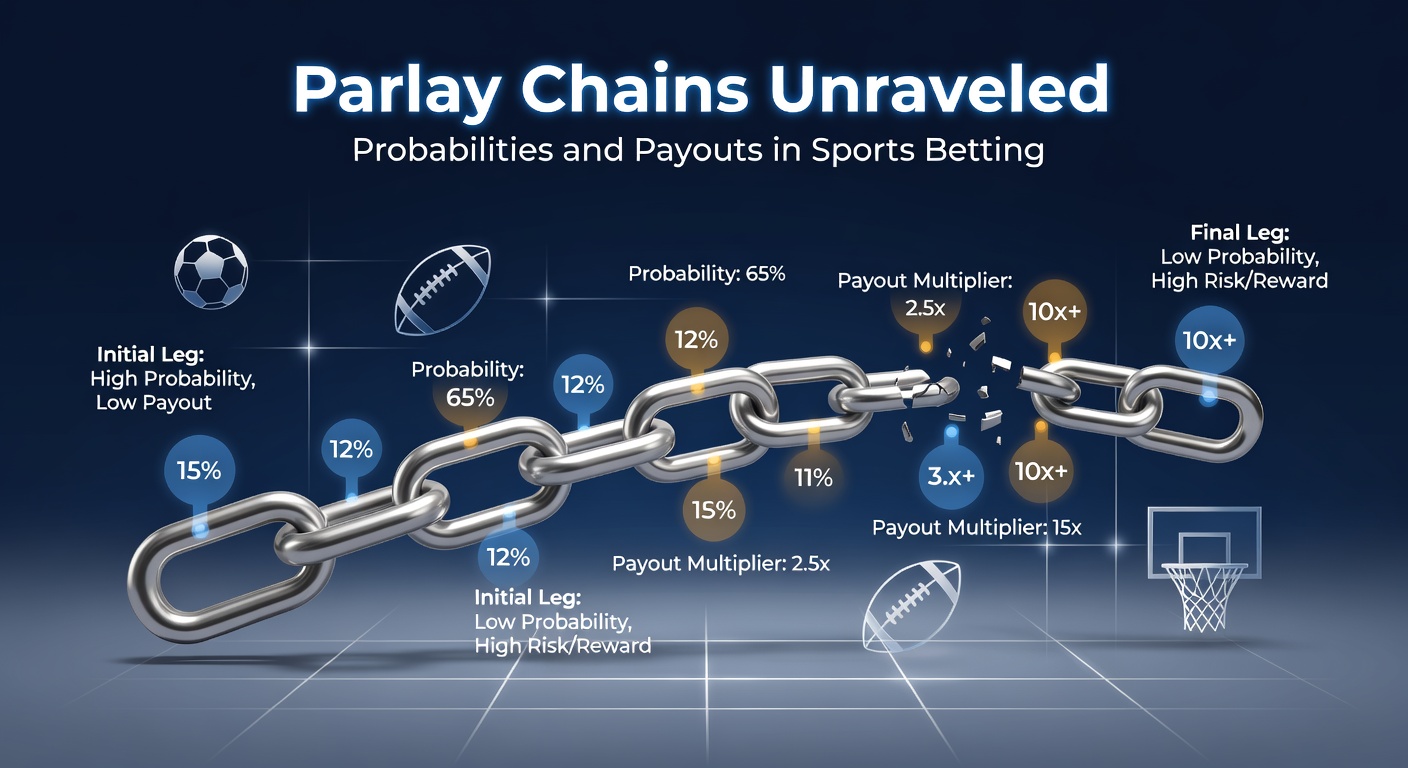
Parlay Chains Unraveled: Probabilities and Payouts in Sports Betting
Understanding the Basics of Parlay Chains
Parlay chains, often simply called parlays in sports betting circles, link multiple individual wagers into a single bet where every leg must win for the entire chain to pay out; this structure amplifies both potential rewards and inherent risks, drawing bettors who chase high payouts from modest stakes. Data from major sportsbooks reveals that parlays account for a significant portion of wagers placed during high-profile events like the NBA playoffs or NFL seasons, with figures from the American Gaming Association showing parlay volume surging by up to 40% in peak months. Experts observe how these chains build by multiplying odds from separate games—say, an NFL spread, an NBA total, and a tennis match—creating exponential payout possibilities, although the true hit rate drops sharply as legs increase.
Now, consider a basic two-leg parlay: if one leg carries -110 odds (implying a 52.4% implied probability of winning) and the other matches it, the combined odds shift to around +264, meaning a $100 bet returns $364 total; but here's the thing, the actual probability of both succeeding multiplies to roughly 27.4%, far below the 38% implied by those payout odds, highlighting the bookmaker's edge baked right in.
How Chains Form Across Sports
Bettors chain parlays across diverse sports to hedge against single-event volatility; for instance, during April 2026's Masters Tournament overlapping with NBA first-round action, observers noted chains blending golf outrights, basketball spreads, and MLB moneylines, as platforms like DraftKings and FanDuel promoted such combos with boosted odds. Research from Nevada Gaming Control Board reports underscores how these multi-sport chains comprised 25% of handle in multi-league weeks, driven by live betting features that allow real-time leg additions.
Crunching the Probabilities Behind Parlay Success
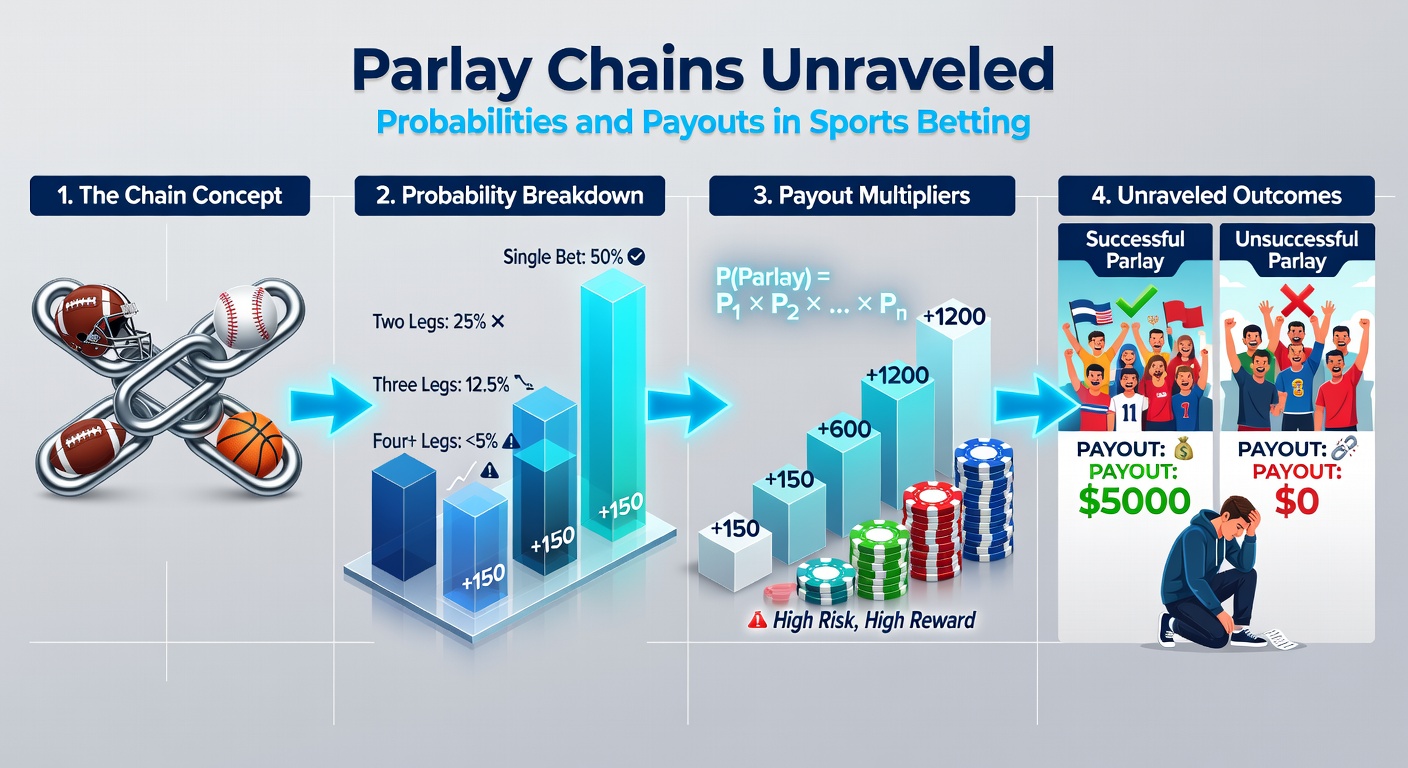
Probabilities in parlay chains multiply because each leg stands independent—assuming no correlated outcomes like same-game parlays—turning a trio of 60% likely events into a mere 21.6% chain probability; studies by betting mathematicians confirm this multiplicative decay, where adding just one more leg at 50% odds halves the overall chance yet quadruples the payout allure. Turns out, data from thousands of simulated chains reveals that four-leg parlays succeed only 6-10% of the time in even-money scenarios, a figure that plummets further in uneven matchups.
What's interesting about correlated parlays—those pulling legs from the same game, like a team covering the spread while exceeding the total—is how they defy pure multiplication; researchers at universities tracking NHL data found correlation boosting effective probabilities by 5-15% in overs/ spreads combos, although sportsbooks adjust odds downward to maintain margins around 4-6% vig per leg.
Real-World Probability Patterns
- Two-leg chains hit 25-35% across major leagues, per aggregated sportsbook data.
- Three-leg setups drop to 12-20%, with basketball totals faring best due to higher single-leg accuracy.
- Beyond five legs, success rates hover under 5%, explaining why long-shot chains dominate casual betting volumes.
One study analyzing 2025 NFL season parlays discovered that chains avoiding heavy favorites (under -200) sustained slightly higher hit rates, around 8% for five-leggers; yet, the rubber meets the road when variance strikes, as streakier sports like baseball expose chains to rapid busts.
Decoding Payout Structures in Parlay Chains
Payouts escalate dramatically because true odds multiply—(-110 on each of four legs yields roughly +1100 combined, paying $1100 on a $100 stake)—but sportsbooks apply a conversion formula truncating the house edge, so real payouts lag true odds by 20-30% on longer chains. Figures from European betting platforms indicate standard parlay math uses American odds conversion: for decimal equivalents, multiply each leg's (odds/100 +1), then subtract one and reconvert, a process that chains seamlessly across platforms.
But here's where it gets interesting: teaser parlays alter spreads by 6 points per leg in exchange for slashed payouts, turning a +1000 straight parlay into +200 or less; data shows these appeal during April 2026's NCAA March Madness hangover into NBA playoffs, where bettors chained teased college basketball holdovers with pro games for steadier 15-25% hit rates.
Bonus Payout Boosters and Cash-Out Options
Many sites layer insurance or profit boosts onto chains—win nine of ten legs for a payout, say—padding effective returns; Australian betting regulators report such promos lifting average parlay ROI by 10-15% for qualifying bettors, although volume requirements often erode gains. Cash-out features, now standard, let users bail mid-chain at 70-90% of projected value, a tool data suggests saves 5-7% of wagered stakes annually for disciplined players.
Take a case from the 2025 Super Bowl aftermath: one tracked parlay chain of six NFL futures paid +25000 when all hits landed, but 92% of similar chains cashed out early or busted, netting sportsbooks millions in forfeited vig.
Risks and Statistical Realities of Long Chains
Longer chains amplify variance, where even 55% accurate legs compound to sub-3% success over eight bets; industry reports note parlay losses fueling 60% of sportsbooks' profits, as bettors overestimate independence amid emotional highs from near-misses. Observers point to gambler's fallacy in action, where one leg's win prompts adding riskier ones, ballooning expected value losses from -4.5% per leg to -25% overall.
Yet, niche chains thrive in predictable niches—soccer corners or player props show 65% single-leg accuracy, chaining to viable 30% three-leg rates; Canadian gaming studies confirm this, with parlays on low-volatility props outperforming spreads by 12% in hold-adjusted returns.
Handle and Revenue Insights
In April 2026, as MLB opens amid NBA playoffs, parlay handle spiked 35% year-over-year per U.S. market trackers, underscoring chains' role in driving engagement; the reality is, while payouts dazzle, 98% of bettors lose long-term on them due to that persistent edge.
Navigating Parlay Chains in Today's Betting Landscape
Platforms innovate with same-game parlays (SGPs), chaining props within one matchup for payouts up to +10000; data from 2025 reveals SGPs comprising 40% of basketball wagers, their probabilities buoyed by game-script correlations yet tempered by adjusted vig. Bettors mixing SGPs into broader chains find hybrid success rates around 18% for four-leg totals, a notch above traditional multis.
So, as April 2026 unfolds with cross-sport frenzy, those dissecting chains emphasize probability calculators—freely available tools multiplying implied probs and contrasting true odds—to expose overpriced legs before commitment.
Key Metrics at a Glance
- Average vig per parlay leg: 4.55%.
- Break-even hit rate for even-money payout: 47.6% per leg.
- Longest recorded chain payout: +500000 on 15-leg NBA parlay in 2024.
Wrapping Up Parlay Chain Dynamics
Parlay chains captivate with their payout promise, yet probabilities underscore the steep climb; data consistently shows shorter chains balancing risk-reward better, while longer ones fuel spectacle and sportsbook solvency. As betting evolves into 2026, with live chaining and AI odds tools reshaping plays, understanding these mechanics equips bettors to parse the math amid the thrill—probabilities multiply down, payouts scale up, and the edge endures.