
Poker Variant Proliferation Drives Changes in Online Platform Popularity
Online poker platforms have expanded their game libraries over the past decade, moving beyond traditional Texas Hold'em to include formats such as Pot-Limit Omaha, Short Deck Hold'em, and mixed game rotations that feature Seven Card Stud alongside Razz and Badugi. This shift reflects operator responses to player data showing demand for variety, and figures from industry tracking services indicate that sites with broader variant selections often record higher session counts and longer average play times.
Observers note that operators began accelerating variant additions around 2018, when traffic analytics from multiple networks revealed stagnation in Hold'em-only rooms. By introducing Omaha variants with four-card starting hands and different betting structures, platforms attracted participants who previously avoided standard cash games. Research from academic sources on gambling behavior has documented how these additions correlate with increased retention rates, because players encounter new decision trees that require adjusted strategies.
Player Segmentation and Format Preferences
Data compiled across European and North American markets shows distinct groups gravitating toward specific variants. Recreational users frequently select Pineapple or Crazy Pineapple for its added draw elements, while professionals concentrate on Pot-Limit Omaha high-stakes tables where pot odds calculations differ substantially from Hold'em. Reports prepared by the American Gaming Association highlight that platforms offering at least eight distinct poker formats experienced average monthly active user growth of 12 to 18 percent between 2022 and 2025, compared with single-format sites that remained flat.
Regulators in multiple jurisdictions track these patterns through license reporting requirements. In June 2026, aggregated statistics released by iGaming Ontario demonstrated that multi-variant rooms captured 67 percent of total poker handle within the province, up from 49 percent recorded three years earlier. This redistribution occurred alongside regulatory approvals for new game types, including Big O and Triple Draw variants that operators added after demonstrating compliance with fairness standards.
Site Traffic Metrics and Competitive Positioning
Traffic comparison tools used by affiliate networks reveal measurable differences when sites expand their offerings. One study conducted by researchers at the University of Nevada examined login and table occupancy data from 14 major skins operating under the same network. Rooms that introduced Short Deck Hold'em alongside existing cash games saw peak-hour table counts rise by an average of 23 percent within four months of launch, whereas control sites without new variants recorded no comparable increase.
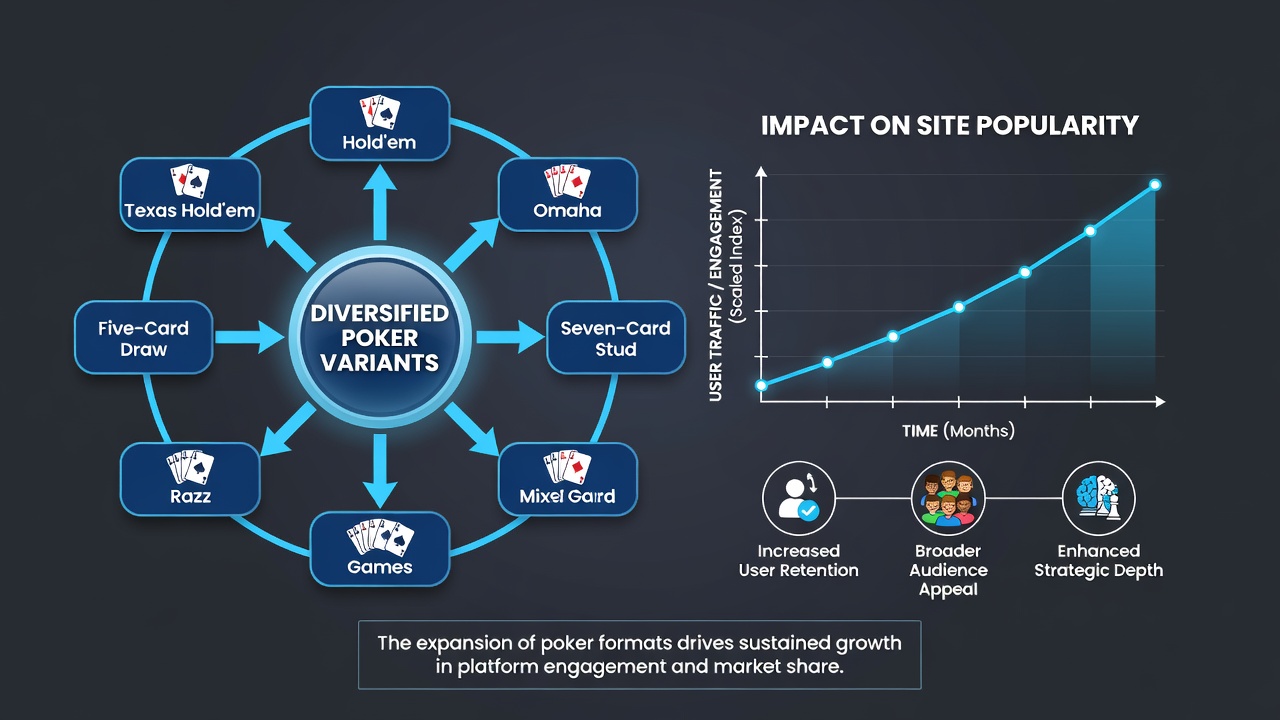
Operators have adjusted marketing accordingly. Targeted promotions now emphasize mixed-game tournaments and variant-specific leaderboards rather than blanket Hold'em freerolls. These campaigns align with findings from the Canadian Gaming Association that players who sample three or more variants within their first month demonstrate 31 percent higher lifetime value than those who remain in a single format. The association's annual industry review notes that this pattern holds across both desktop and mobile channels.
Regulatory and Technological Enablers
Expansion of variants has depended on updates to random number generator certifications and user interface adaptations that accommodate different hand rankings and betting rounds. Licensing bodies such as the Malta Gaming Authority require operators to submit mathematical models for each new variant before approval, creating a documented record of how format diversity has grown under supervised conditions. These requirements have not slowed rollout; instead, they have standardized testing procedures that allow quicker integration once models clear review.
Networked platforms benefit particularly because shared liquidity pools support multiple variants without fragmenting player pools excessively. When a single shared table roster includes Hold'em, Omaha, and Stud tables running simultaneously, players can switch formats without leaving the ecosystem. Tracking data released by network operators shows cross-variant play occurring in 38 percent of sessions longer than 90 minutes.
Conclusion
Variant diversification continues to reshape traffic distribution among online poker platforms. Available statistics from regulatory submissions and academic analyses indicate that sites maintaining broader libraries sustain higher engagement levels, while single-format operators face relative stagnation in user metrics. As certification processes evolve and player data systems improve, further format introductions remain likely through at least the end of the decade.