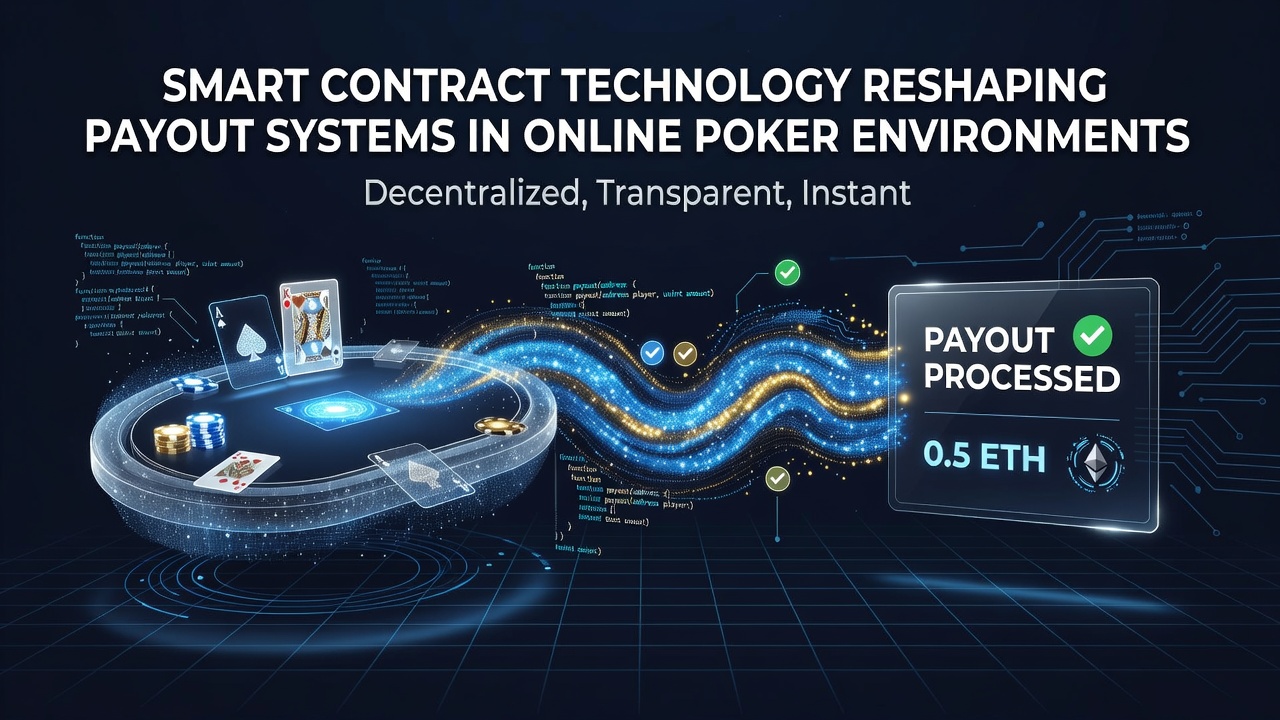
Smart Contract Technology Reshaping Payout Systems in Online Poker Environments
Blockchain Foundations Meet Poker Operations
Online poker platforms have begun integrating smart contract protocols to handle player payouts directly on distributed ledgers, and this shift replaces traditional payment processors with automated code that executes when predefined conditions are met. Smart contracts written in languages such as Solidity run on networks like Ethereum and its layer-two scaling solutions, releasing funds only after game results are verified through oracle feeds or on-chain consensus mechanisms. Data from several blockchain analytics firms indicates transaction volumes tied to poker payouts increased steadily through 2025, with further adoption noted in August 2026 as more operators migrated settlement layers away from centralized databases.
Traditional Settlement Compared with Automated Execution
Conventional poker sites collect rake, hold player balances in custodial wallets, and process withdrawals through banks or e-wallets after manual compliance checks; these steps introduce delays that can last hours or days. In contrast, a smart contract receives the outcome hash from a verifiable random function, confirms the winning hand against the recorded state, and transfers the prize pool minus the agreed rake percentage within seconds. Observers note that platforms adopting this model reduce operational overhead because no human staff needs to approve each transaction, while players receive cryptographic proof that the contract code has not been altered since deployment.
Transparency and Audit Trails
Every payout instruction and game state transition is recorded in an immutable block, allowing independent auditors to reconstruct entire tournament histories without requesting data from the operator. Research published by the Blockchain Research Institute shows that public verification of payout logic cuts dispute resolution time by more than half in environments where participants can read the contract source code. Operators still maintain off-chain components for user interfaces and customer support, yet the financial settlement layer remains fully on-chain and therefore open to examination by regulators or third-party analysts.

Regulatory Developments Across Jurisdictions
European authorities outside the United Kingdom have issued guidance on tokenized gaming assets, and several operators now reference these frameworks when deploying contracts that lock player deposits until results finalize. In Australia, the Australian Transaction Reports and Analysis Centre updated its digital currency exchange rules in early 2026 to include smart-contract-based gambling settlements, requiring operators to implement know-your-customer checks before funds enter the contract. Canadian provincial regulators continue to evaluate similar requirements, while certain U.S. state gaming commissions have begun pilot programs that accept on-chain audit reports as part of licensing renewals. These parallel developments, visible by August 2026, demonstrate that multiple regions are adapting existing financial technology rules rather than creating entirely new statutes for poker-specific smart contracts.
Technical Implementation Patterns
Most current deployments use a hybrid architecture where the poker client runs on centralized servers for speed, yet each hand result is hashed and submitted to an oracle network that feeds the data into the payout contract. Multi-signature wallets controlled by the operator and an independent escrow service hold the prize pool until the oracle confirms the outcome, after which the contract distributes winnings according to the coded rules. Gas fees on layer-two networks have fallen below one cent per transaction, making micro-payouts for sit-and-go tournaments economically viable. Engineers who maintain these systems report that upgradeable proxy patterns allow contract logic to be patched without moving existing funds, addressing concerns about immutability when regulatory requirements change.
Security Considerations and Incident Response
Although smart contracts eliminate certain human-error risks, they introduce code-level vulnerabilities that require formal verification and regular audits by specialized firms. A documented case in 2025 involved a reentrancy flaw in an early poker contract that allowed an attacker to drain a small liquidity pool before the vulnerability was patched through a coordinated upgrade. Industry groups such as the Global Blockchain Business Council now publish recommended audit checklists that cover access control, oracle reliability, and emergency pause functions. Players retain the ability to verify that their deposits sit in a contract whose bytecode matches the audited source, yet they must still trust the oracle feed and the operator's front-end software for the actual gameplay experience.
Player Experience and Adoption Metrics
Withdrawal times have shortened from an average of 48 hours to under five minutes on platforms that fully migrated settlement to smart contracts, according to aggregated user reports shared on independent forums. Newer entrants to the market often advertise these instant payouts as a competitive feature, while established sites introduce optional on-chain modes alongside legacy payment rails. Surveys conducted by academic researchers at the University of Nicosia indicate that users who have completed at least one smart-contract payout report higher confidence in fund security, although many still cite the need for clearer wallet onboarding instructions. Transaction volume figures reveal that roughly twelve percent of global online poker liquidity had moved to some form of automated settlement by mid-2026.
Conclusion
Smart contract technology continues to integrate into online poker payout systems through incremental adoption across multiple regulatory environments, supported by falling transaction costs and maturing audit practices. The shift replaces manual approval workflows with deterministic code execution, while preserving the need for robust oracle feeds and front-end security. As of August 2026, operators and regulators alike are refining implementation standards that balance transparency with player protection, resulting in settlement processes that are faster and more verifiable than previous centralized models.